Sunday, May 29, 2011

Nathaniel Fludd Beastologist: Flight of the Phoenix by R. L. Lafevers and Illustrated by Kelly Murphy

This series novel was enjoyable. The story was fast pace and simple. The adventure the protagonist goes on will only make children want to read the next book. The book is definitely intended to go on as it doesn’t quite end.
Although the fast paced adventure will be loved by students I found the book’s quality somewhat lacking. Lafevers does not use much descriptive language or many sensory details. As with other novel writers she does not paint pictures with her words. Lafevers does a good job of drawing readers into her story she does not do a good job of using descriptive language to totally make her world of beastologist believable. Although Lowery does a great job of making her world logical and thinking through all the details to make it realistic where Lafevers’s story is too rushed to create a complete world.
I would allow this book on my shelf as a free read but only for third and forth graders. The language and literary skills are too simplistic for upper grades. I would not read this book aloud as I do not find this novel as well written as others.
Published: 2009

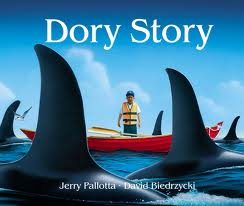
Dory Sory by Jerry Pallotta and Illustrated by David Biedrzycki

I enjoyed this story. At first I thought that it might be too flat and dry but as the story progressed I became hooked. In just a few short pages Pallotta captures his readers through suspense and descriptive detail. I also found the illustrations to be fascinating as some looked as if they really were a picture and not a drawing.
Pallotta uses descriptive words that sound like what they mean such as “splash.” He also grips his readers with the added suspense on whether the protagonist will make it out alive. He not only utilizes great literary skills but also teaches about the food chain. Any students who read this book will be gripped with the excitement of the first person narrative, almost imagining that they are there as well.
           The illustrations add to the story as well. They add to the tension with the muted colors and contrasting red. Biedrzycki also seems to master the underwater world of fish not only capturing what is happening in the book but allowing readers several glances to take it all in.
           I might use this book as a read aloud. It would definitely entice children. I think that although most ages would appreciate this book it is geared for the younger ages. I might use this book for an introduction on a unit about the ocean or the food chain. It might also be a good book to discuss the word suspense and first person. I recommend this book.
           It is also important to note a the publishing information is at the back of the book so that the story starts on the first page.
Published: 2000

Octopus Oyster Hermit Crab Snail A poem of the Sea written and illustrated by Sara Anderson


I enjoyed this book, although I was not in love with it. I found the illustration nice and quaint and it was a fun book to read. I would never read it as a read aloud but I would have it on my shelf. The entire book is a poem and Anderson does a good job with her rhyming. Although she does not use perfect rhyme she does set up a pattern.
            Anderson’s illustrations are very colorful with muted tones to help set the mood for her poem. She also make’s her cover continue onto the back with her ocean background also beginning before the publishing information. She has a distinct style that brings imaginative life to her little sea creatures. This book would be good for students who are learning about poetry as the entire book is one. She uses great vocabulary such as “scurry” and “clatter” to get her point across. These worlds really draw on the sensory details Anderson wishes to get across to readers.
I would use this book as a free read in my room. I would also recommend in to students if we are doing a poetry unit. I would not choose it as a read aloud since I think I can find some better poetry literature out their but it is always an option.
Published: 2005

Underwater Counting by Jerry Pallotta and Illustrated by David Bierdrzycki

I absolutely love this book. I usually am not a big fan of counting books but this book is not your typical counting book.
I knew I was in for a treat because the cover continued its picture onto the back of the book. The author’s and illustrator’s name is written in a wave shape on the covers along with the title. The illustrations were beautiful. The flashy colors made the underwater life truly come alive. Bierdrzycki also made his fish look realistic enough that one might just do a Mary Poppins and reach into the picture and touch them. Yet, he also still has an almost mystical appearance that would entice readers on a fascinating journey through the sea counting fish. He has the fish appear as if you might see them at sea. They are not in neat little rows like some counting books but sometimes only a part of a fish will appear or some might be draped in shadow the further into the deep ocean the reader ventures.
            The illustrations are not the only exciting thing about this book but so is the text. The text is not a typical counting book. Pallotta uses comedy as it goes through counting the fish. He also gives insightful scientific facts when on each page about the fish. The counting almost becomes secondary in the excitement of all of the different kinds of fish being discussed and what is unique about each. However, Pallotta does not tell his readers his facts but shows them. He does a very good job of making the reader feel like the expert and not using any condescending tones. Sometimes “counting books” after the age four can seem too simple and babying. They uses phrases like “can you count all the fish?” or “lets count the fish, 1,2…”  Pallotta does not. He uses phrases like “These eight sailfish are a type of billfish.” This book does not only teach students how to count but will teach students about fish and the sea. It will also expand their imaginations as they view Bierdrzycki’s illustrations.
I would use this book with any age student. Although it is a counting book the illustrations and text would be engaging and enjoyable. This book also will help children learn not only how to count to ten but all the way to fifty. This would be a great book for parents to read to their children and for students as a read aloud let alone in their library. I recommend this book to all teachers.
Published: 2001

Saturday, May 28, 2011

It’s A Secret written and illustrated by John Burningham

I found this book rather boring. I did not find the illustrations elaborate or incredibly detailed. They were simplistic in form and did not add any new insights to the story. I did not enjoy this book.
            Although Burnningham distinctly chooses several distinct colors to use throughout the story, the illustration’s styles looked as if they were drawn with pencil and marker or crayons.  The text had a specific pattern and rhyme as many children’s books do. It takes readers on an imaginary journey to where cats go at night but the tale is bland with any sensory or imagery details. The tone at times nears that of condescending. Although Burningham is a well know author I did not much care for this book and do not recommend it to other teachers. I feel in comparison to several others the masterful picture books I have read over the course of the weeks that there are more insightful and equipped books out there.
Published: 2009

Art & Max written and illustrated by David Wiesner


I did not mean to get another Wiesner book. I was in the library flipping through books and was captured by this one’s elaborate illustrations. I took it home. It was not wordless so I didn’t think to check and see if it was Wiesner. I guess it goes to show why he won the Caldecotte Medal three times, (only the second person in history to do that). This book is not only a fantastic story about a little lizard attempting to paint but teaches students through showing (not telling) how to paint. He takes painting to its very basic elements of line, shape and color. As Max attempts to fix Arthur he learns how to point. Students will not only be craving to read this book over and over again but they will gain basic knowledge in painting.
Wiesner uses detailed illustrations that tell his story. The masterful details make each read have new insight into the characters, places and story. He uses a variety of colors to get his comical story across. The words add to the story but very few of them are needed to understand the story. His illustrations almost do the job for themselves as seen in Flotsam and Tuesday.  Wiesner is highly capable of doing this.
I would recommend this book to all teachers. I think this is a must have for art teachers. I would use this book when discussing art in class. I also would have it in my classroom as a read aloud. Like all of Wienser’s books this is a great read for all ages.
Published: 2010

The Red Book by written and Illustrated by Barba Lehman


I found this book to be a lot of fun. I enjoyed the idea of a magical book and adventurous journey using balloons to fly. This is another wordless book that I found entertaining and enjoyable.
The qualities of the illustrations themselves did not compare to the elaborate illustrations of David Wiesner, but they did have their own flair. They were simple in shape but did have detailed images of space and location. There were also moments where they read more like a graphic novel with several pictures stacked up on each other. She uses complementary colors and line to shape her images. The character’s emotions were neatly conveyed on the characters faces without words. Allowing the reader to be the expert and discover what was happening.
I might have this book in my library. I would not choose it to have it read aloud due to the fact of its simple illustrations. It is a great book for students interacting in the reading process for the first time. Therefore I recommend this book for younger grades. Although Wiesner’s masterful illustrations would be enjoyable and fascinating even for the upper grades Lehman’s does not.
Published: 2004